
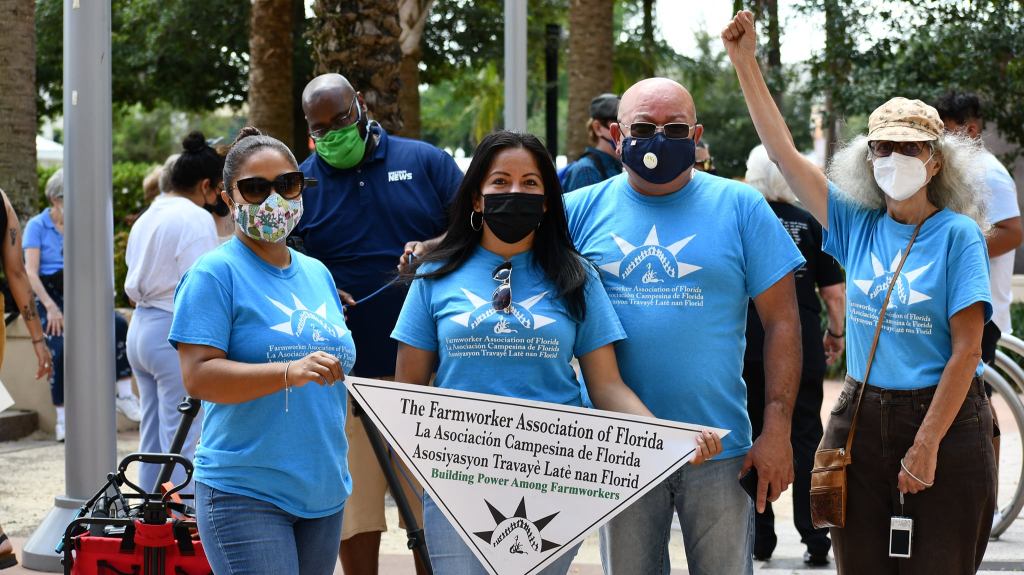
The Farm Workforce Modernization Act gained bipartisan support from Congress, but split advocacy groups down the middle. (Gianna Gronowski)
The Farm Workforce Modernization Act of 2021 is the sole true bipartisan legislation out of a trio of immigration reform proposals, yet continues to divide activist groups.
The U.S. Citizenship Act and Citizenship for Essential Workers Act each lack the bipartisan support needed to pass, but the Farm Workforce Modernization Act has support from both Democrats and Republicans.
On Mar. 18, 2021, the U.S. House passed the Farm Workforce Modernization Act, a bill introduced for the second time to Congress. The bill would pave a way to citizenship for essential farmworkers that are undocumented immigrants.
Texas Rep. Veronica Escobar (D) called the bill “long overdue.” The day of its passing, a rally in support of the bill led by immigrant youth was held outside the Capitol.
Originally introduced by Rep. Zoe Lofgren (D-CA) and Rep. Dan Newhouse (R-WA), in collaboration with activist groups United Farm Workers Foundation and Farmworker Justice, the bill would allow undocumented immigrants that have worked on a farm for at least 180 days within the past two years apply for certified agricultural worker status, which prevents deportation, and allow for renewal every five years.
The protected agricultural workers would have to remain farmworkers for eight more years to qualify for permanent legal status.
Advocacy groups take issue with this condition, saying the agricultural industry has very high rates of injury, work-related death, domestic violence and sexual assault, unfair wages and wage theft. Mandatory additional years in the industry bodes risk and an uncertain future for immigrant workers.
The only way to bypass the eight year requirement is to provide written documentation an individual has been a farmworker in the U.S. for a decade prior to the FWMA passing, which would cut the additional farmworker requirement in half to four years. However, activist groups say farmworkers often receive cash wages and make handshake agreements, leaving no paper trail to support their history.
Injured workers would also be excluded from the program, as noted by activist group Food-Chain Workers Alliance.
The FWMA would also broaden the H-2A guestworker program, which requires employers to provide housing, meals, above minimum wage, and other standards of living. It is not uncommon for guestworkers to receive substandard meals, living conditions, and wages in these programs, and an expansion on the program would run already strained resources thinner, according to Food-Chain Workers Alliance.
Currently, there is no annual cap on the number of guestworkers a single employer can take on, and the H-2A program has already tripled in size since 1996.
Former House Ways and Means Committee Chairman Charles Rangel called the guestworker program “the closest thing I’ve ever seen to slavery.” He said employers “import” immigrant workers, who are then chained to their employers for years out of fear of deportation.
Southern Poverty Law Center called the H-2A program a modern day Bracero program. The 1942 Bracero program brought in Mexican farmworkers, originally intended to harvest sugar beets in California. By the time the program was abolished in 1964, a total of 4.5 million jobs had been filled by Mexican citizens.
“We oppose the Farm Workforce Modernization Act because it expands the H-2A bracero program, which just treats farmworkers as cheap labor for growers and discriminates against our families,” Rosalinda Guillen, Director of Community2Community, said.
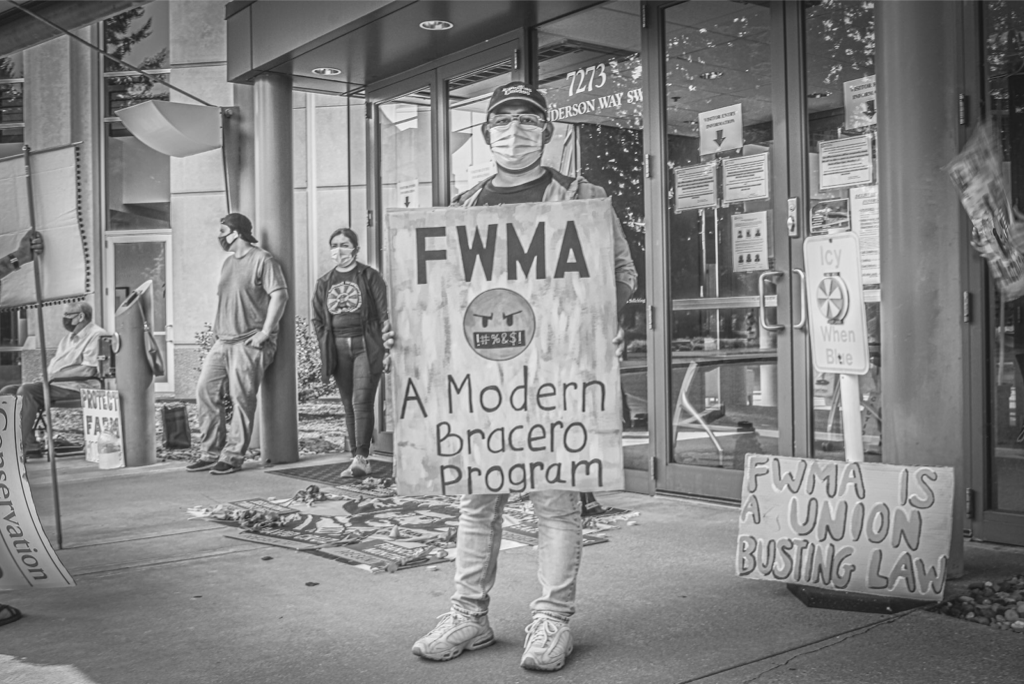
The biggest criticism of the FWMA is the requirement that employers use the E-Verify program.
Farmworker Justice estimates at least half of agricultural workers in the U.S. are undocumented immigrants. The E-Verify program requires employers to look up records of workers to determine if they are undocumented. If found to undocumented, the employer is required to terminate them.
E-Verify has been linked to workplace raids, detention, and deportation, jeopardizing the safety of the workers and their families.
The first state to mandate E-Verify for all new hires was Arizona in 2008. Former Arizona Republican Sen. Rich Crandall said E-Verify “was promised as the silver bullet to immigration problems.”
Arizona’s immigrant population reduced by 17% following the implementation of E-Verify, until the industry found a way around it.
Undocumented workers can submit a permanent resident’s identification papers in place of their own, known as identity loans. A victimless crime, these identity thefts are often hard to stop. Employers can also choose to ignore the results of the identity check, as there is no real enforcement for those who misuse the system.
“We deserve a comprehensive reform that includes a path to citizenship without excluding anyone who deserves to be legally working and contributing to the growth of this country, a country that we consider ours too,” said farmworker Luis Jimenez, president of the Alianza Agricola. “We have already waited a long time to achieve a change; it is time and we are not going to settle for crumbs.”
The Farm Workforce Modernization Act is currently in the Senate Committee on the Judiciary.
 gianna gronowski
Leave a comment